
Treants
From Rune's Guide to Mystical Beasts Volume I - Mage Hunter

Hello loyal readers! Thank you again for tuning in for another exciting work of fiction.
The mystical beasts of Nyrth can be as dangerous, if not more so, than regular fauna. If you’re not careful, they can entangle you and crush you with their powerful roots! Today, Rune will be sharing you an entry from her compendium, exploring the anatomy, abilities, and the dangers of treants.
As a reminder, your feedback is critical to the success of Thunderous Fantasies. Be sure to check the link here for a survey so I know what kind of content you like to see.
https://thunderousfantasies.substack.com/survey/1996110
Before we dive into Rune’s educational exploration into these tree-like creatures, lets hear from our bard, Kibbolt!
Uprooted - By Kibbolt
Never travel into the forest alone,
for the trees have eyes.
Their roots, for miles they’ve grown,
waiting in their guise.
You are surrounded, yet you cannot tell – they are everywhere.
A paranoia, most deserved, one we shall all share.
Before you know it, they’ll entangle you,
strangle you, and dangle you.
Entombed by their web of lumber and bark,
cry as you might, it will not hear their hearts.
So you best start…
praying.
Enjoy the poem? Before continuing, consider subscribing to help support Thunderous Fantasies!
Treants
From Rune's Guide to Mystical Beasts Volume I - Mage Hunter
A most tricky, and grueling encounter that most adventurers may face are the mystical treants. These magic, tree-like creatures not only are easy to miss, camouflaged among the forestry to the untrained eye, they act as clever, intelligent predators. If engaged in combat, their thick bark-skin is strenuous to armaments, as it is to an adventurer’s stamina and resolve.
Physical Characteristics
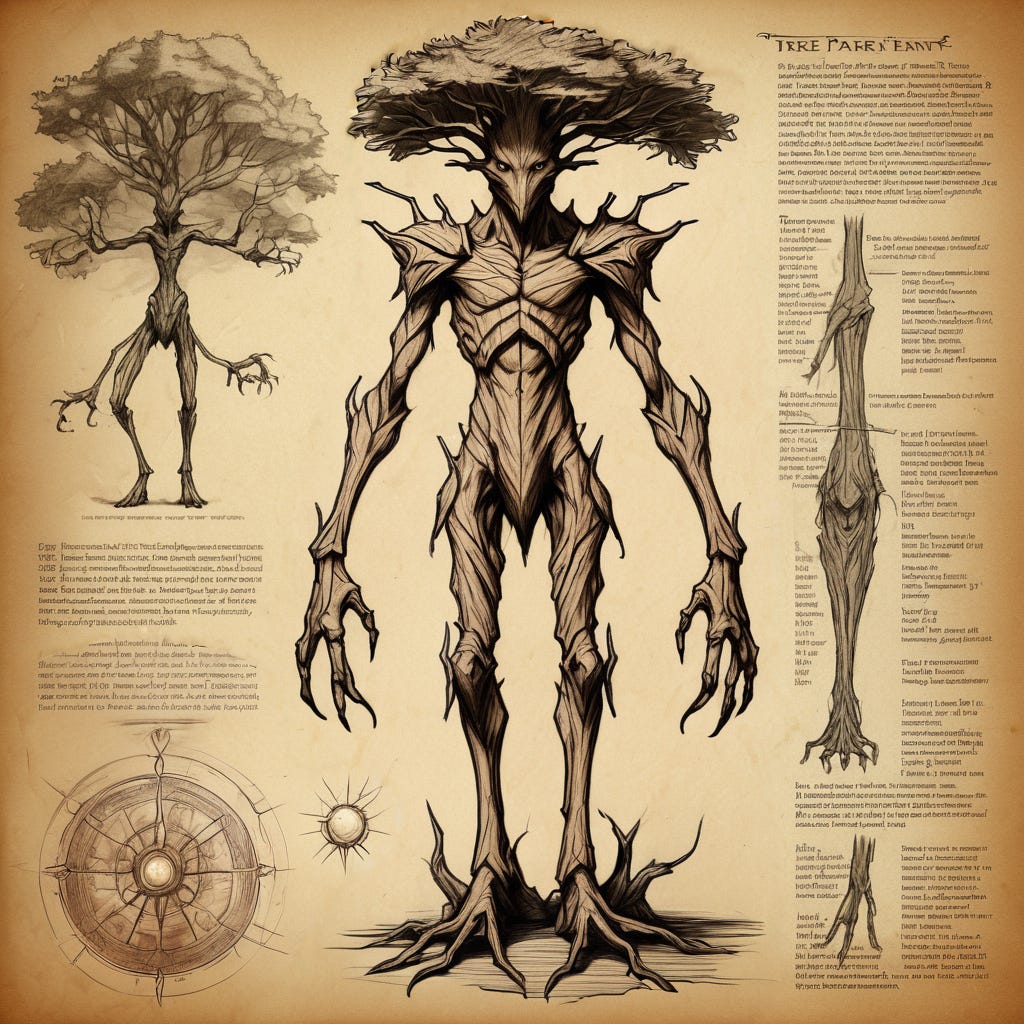
The skin and “flesh” of the treants are identical to the wood of most trees, and equally as durable. Most treants stand between 8-10 feet tall. However, studying these creatures indicate great potential to grow even bigger. Yet no records indicate the existence of elder treants beyond the Feyline. While unlikely, it is best for adventurers to be prepared for all situations, including the possibility of a giant treant slumbering in the forest.
They appear vaguely humanoid looking in shape, but they can alter the number of limbs at any given notice.
Within their wooden frames lie a magical energy core. Typically located in the upper chest region, this energy core is enveloped by a viscous bulb. This “heart” contains a vast supply of mana, which can be seen through the seams of their bodies as golden light. If extracted successfully, could be a valuable resource for enchanting and crafting. This “organ” is the only organ these creatures have, as the rest of their bodies are filled with wood.
Combat Recommendations
Avoidance is the best principle of survival for any dangerous creature. Treants may appear invisible to the untrained eye, but if you study the general outline in the above artist rendition, you can spot treants even in the most densely populated forests. The best way to detect them, however, is through magical detection solutions, as their core is an easy target to spot using this method. Do note their golden magical aura is not always visible, and they hide this glow when they are resting or stalking.
Because treants are typically shorter than most natural trees, traveling and camping in areas of taller, matured trees make it easier to spot them.
If engaged with these magical creatures, know that they are capable of extending their roots between 30-50 feet, which may be used to entrap their victims. They primarily use a combination of strangulation, crushing, or sometimes use druidic magic to dispatch their victims, and can use their own micro ecosystems as a form of self-defense, employing the use of insect swarms. Frequently, coming into direct contact with their bark can cause violent rashes, and in some rare instances, poison.
Ideally, using magically enchanted weaponry is the best means of taking down treants. Sawtooth weapons, axes, and bludgeoning weapons are recommended if the adventurer does not have access to a magically enchanted weapon. However, because of their durable wood bodies, many travelers who fought these beasts suffer great damage to their tools. While a piercing weapon, like a spear, could theoretically strike the core directly, this would require extreme precision through the seams of the body, which is not always a guaranteed option as each treant has different openings.
Fire is a Last Resort ONLY
This report is sourced from the Artemis Adventuring Hall.
An adventuring guild from Clydesdale encountered treants while journeying for an assigned quest. Among them was a wizard who employed the use of fire magic. While fire would be an obvious bane against treants, it proved to be more deadly to the adventurers.
This caused a wildfire to spread, and burnt down dozens of acres of forestry. When their bodies were recovered, not only did they suffer severe burns, but there were many signs of extreme bruising, cracked bones, and ruptured organs. Multiple trails of fresh roots were also observed at the site, indicating they were surrounded by treants.
While fire is indeed a weakness, it is highly not recommended unless in an extremely dire situation. Fire poses a great risk of causing wild fires. It can also signal as a cry for help for treants. The disadvantage of running away from a forest fire, and pursued by treants who can entrap you at any corner, will make it more difficult to escape.
The only exception would be the use of Fae Fire, specialized druidic flames that deliver the same effect, while preventing spread across flammable materials. This type of flame will also not cause treants to signal for help.
Another alternative for arcanists is to use ice, though, this will require extreme frigid temperatures to be effective.
Habitat and Behavior
When awake, treants are highly territorial. However, they can lie dormant for years at a time. There’s a high probability you may have seen one and not even know.
Treants never roam outside woodland areas. However, there are some, while rare, instances of mutations that allow them to survive in tundra or desert environments.
They do seem to share some level of intelligence in how they prey upon their victims, exhibiting similar tactics described by ancient hunters as they surround and ambush their prey.
They are assumed to originate from the Feyline, an enchanted realm of forestry occupied by the fae, and there are rumors of their ability to speak, which we will explore later in this entry.
Dietary Habits
Treants typically acquire their sustenance through photosynthesis, absorbing moisture and nutrients from the ground, and sunlight. The Feyline is assumed to provide much richer nutrition for these creatures.
They do, however, gather various fruit or carcasses to feed their micro ecosystems. The larger the treants, the bigger it’s internal ecosystem, and subsequently, the more insects it may host.
If the treants deem their surrounding soil to be inadequate, they will try to migrate to a more suitable location, or hunt creatures to serve as fertilizer.
Seasonal Patterns and Reproduction
Treants are most active during the spring and summer. In fall, they will migrate as close to the Feyline as they can. Alternatively, they will migrate to wherever the most suitable climate is. They will then split their energy core in two and plant one deep into the ground. The parent will be weakened, and its bark will be easier to damage. They can visually appear weathered and greyed during this process, but the parent will eventually recover. If the child core survives the season, it will sprout into a small tree in early spring, which would be extremely difficult to discern from regular trees. It may take five to ten years before a treant sapling gains the ability to move.
For most treants, they go dormant during the winter, and will morph their forms to better fool any suspecting adventurers, for they are the most vulnerable during this season.
A Druids Perspective
Romule Eskay, a retired elven druid, agreed to an interview about the Feyline and the treants. While his adventuring guild, the White Crows, still are active, he and his party are the only ones who successfully entered and exited the Feyline alive.
“The Feyline is a beautiful, yet brutal landscape for outsiders. Entering was almost like a reality shift. The colors, smells, and sounds were amplified. Even the brush of air sent my skin crawling. It tends to rain a lot, and the humidity was oppressive. Yet, not as oppressive as its denizens.”
According to Romule, faes, treants, and the various beasts in the Feyline were unified, working together like a large tribe, all of which seemed to have the ability to channel the weave in some capacity. Even when they seemingly were alone, they felt strange, magical effects of the enchanted forest, as if the forest itself was casting magic upon them; whether it would be summoning rainstorms, shifting trees, or even causing hallucinations. It’s a wonder he and his companions were able to escape.
When asked about why they ventured into this dangerous realm, he explained,
“Wood in the Feyline is rumored to be exotic and powerful resources. Some of the most legendary weapons in lore were known to use wood that originated there.”
While an incredibly dangerous task, they came out successful, and this allowed Romule, and several others of his guild, to retire.
What was most astonishing was his discoveries of the treants, including a massive one which he called “The King Treant.” It was a massive tree, over 500 feet tall. He never saw it move, nor was he able to get close to it, but did describe it having a rich font of mana that can be seen far away. From the distance, he judged a single leaf of its branches to be over a meter long. He deducted because of the massive roots spanning across the entire realm, it was the reason why they were never able to find a spot to rest.
The other treants here tend to grow more massive than the ones outside the Feyline, growing between 10-15 feet tall, and often higher. Despite their sizes, they were still able to move around freely through the forest, thanks to the magical properties of the trees being able to move out of their way. Romule speculates that the trees and treants are interconnected.
With his druidic magic, however, one of the biggest revelations was the intelligence of the treants.
“One of the treants we took down spoke to me before it passed on. I was surprised, as usually druids have to cast a spell like ‘animal speak’ before we can talk to one another. But this treant seemed to cast that sort of spell towards me. I was the only one able to hear it, but it spoke ominously yet clearly.
“It warned us there is nowhere to hide, nowhere to run. And it told us to accept our fate of being food for ‘The Life Giver,’ the ‘King Treant.’”
The Feyline is indeed a dangerous place all travelers should avoid, and one day we will explore more in depth of the Feyline from Romule’s perspective, as he has a lot to share about this mysterious plane.
Editor's Note: This entry is an excerpt from the larger compendium of Rune's Guide to Magical Beasts. For related entries on arcane entities, consult volumes I and II respectively.
Hope you had a good time reading this article! Let us know what you think in the comments!